Content
Repeatability in roll ring grinding means producing the same dimensional and surface-quality outcome across batches and shifts. In a manual or semi-automatic environment small variations in setup, dressing, coolant delivery, or operator technique accumulate into measurable scatter: wheel wear, part runout, eccentricity and surface finish deviations. Automation addresses these root causes by standardizing actions, closing control loops with real-time feedback, and removing or reducing human variability. The result is narrower process capability, more predictable tolerances, and lower rework and scrap rates.
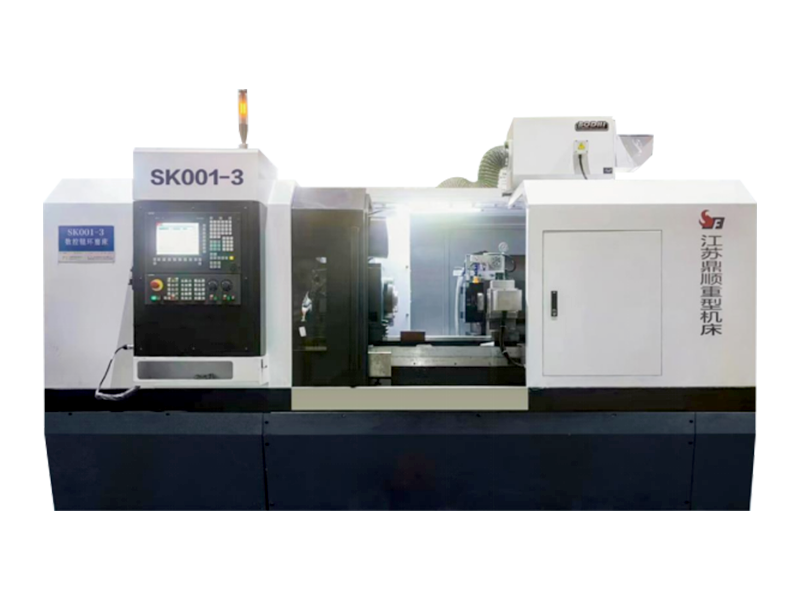
Not all automation is equal. To target repeatability in roll ring grinding, focus on specific features: precise CNC motion control, automated wheel dressing with repeatable profiles, closed-loop measurement and compensation, controlled coolant and filtration, and automated part handling/workholding. Each feature eliminates a common source of variation and, when combined, compounds the repeatability benefit.
High-resolution servo drives and accurate kinematic interpolation keep grinding wheel paths true to programmed profiles. Linear encoders on axes reduce position uncertainty and thermal compensation in the CNC prevents drift during long cycles. When axis motion is precise and repeatable, the grinding pass removes a consistent material amount, producing stable ring geometry across parts.
Automated dressing units restore wheel form and concentricity on a defined schedule or on-demand using wear feedback. Repeatable dressing profiles mean each grinding cycle starts with a wheel geometry equivalent to previous cycles, eliminating one of the largest sources of dimensional and surface finish variation.
Embedding measurement—either in-process touch probes, laser scanners or post-grind gauging—enables closed-loop compensation for wheel wear, thermal growth, and part variation. The controller can apply corrections to offsets, feedrates or wheel depth automatically. This adaptive approach keeps parts within tolerance without manual intervention and shortens run-to-run settling time.
Consistent part location and clamping force are essential for repeatability. Automated hydraulic or pneumatic fixtures provide the same clamping pressure and centering every cycle. Robotic loaders or pallet systems reduce orientation errors and avoid manual misplacement. When you automate fixturing and handling you remove a major operator-dependent variation vector.
Consistent coolant flow and temperature control prevents thermal growth and wheel loading, both of which affect dimensional and surface outcomes. Automated pumps with flow and temperature monitoring, plus closed-loop filtration management, keep the grinding environment stable. In critical applications, temperature sensors feed data to the CNC for real-time thermal compensation.
Automation platforms that collect spindle load, vibration, wheel wear and coolant condition data enable predictive maintenance. By scheduling dressing, bearing service or coolant maintenance based on condition rather than fixed intervals you maintain process consistency and avoid unplanned variation caused by deteriorating machine elements.
Automation enables high-frequency data capture: measured dimensions, wheel offsets, cycle times and operator interventions. Statistical process control (SPC) applied to logged measurements detects drift trends and signals corrective action before parts go out of tolerance. Traceability also helps isolate root causes for repeatability deviations — linking each part to machine state, operator, fixture and material lot.
| Attribute | Manual workflow | Automated CNC system |
| Part-to-part variation | Higher | Lower |
| Time to detect drift | Longer | Faster |
| Ability to correlate root cause | Limited | High (data-rich) |
When upgrading a roll ring grinder, prioritize automations that immediately reduce variation: accurate dressing, closed-loop measurement, and consistent workholding. Add condition monitoring and SPC next to build an intelligent feedback ecosystem. Finally, integrate scheduling, part-tracking and remote monitoring to protect repeatability as production scales and shifts.
Track metrics to quantify repeatability gains: process capability indices (Cp/Cpk), within-part and between-part dimensional standard deviation, scrap/rework rate, first-pass yield and mean time between corrective dressing. Improvements in these metrics indicate that automation is stabilizing the grinding process rather than merely increasing throughput.
Automation is most effective when paired with a process discipline: standard operating procedures, trained technicians who understand control-system outputs, and a feedback culture that uses logged data to refine parameters. Start with a clear measurement plan, validate dressing and probing strategies on trial runs, and expand automation scope based on measured repeatability gains rather than intuition alone.
If you share details about your roll ring sizes, tolerance targets and current bottlenecks (for example: wheel wear frequency, setup variability, or fixture repeatability), I can produce a tailored automation roadmap showing which features to deploy first and expected improvements in repeatability and yield.

 Download Material

 E-mail: [email protected]
  Mob: +86-13806297906
  Tel: +86-513-85562198
  Add:No. 99 Tiantong Road, Nantong City, Jiangsu Province.
Factory scene


Copyright@ Jiangsu Dingshun Heavy duty Machine Tool Co., Ltd. All Rights Reserved.




 English
  русский
  Español
  عربى
عربى